Maximize Your Dental Insurance Benefits in Fallbrook & Bonsall | Year-End Guide
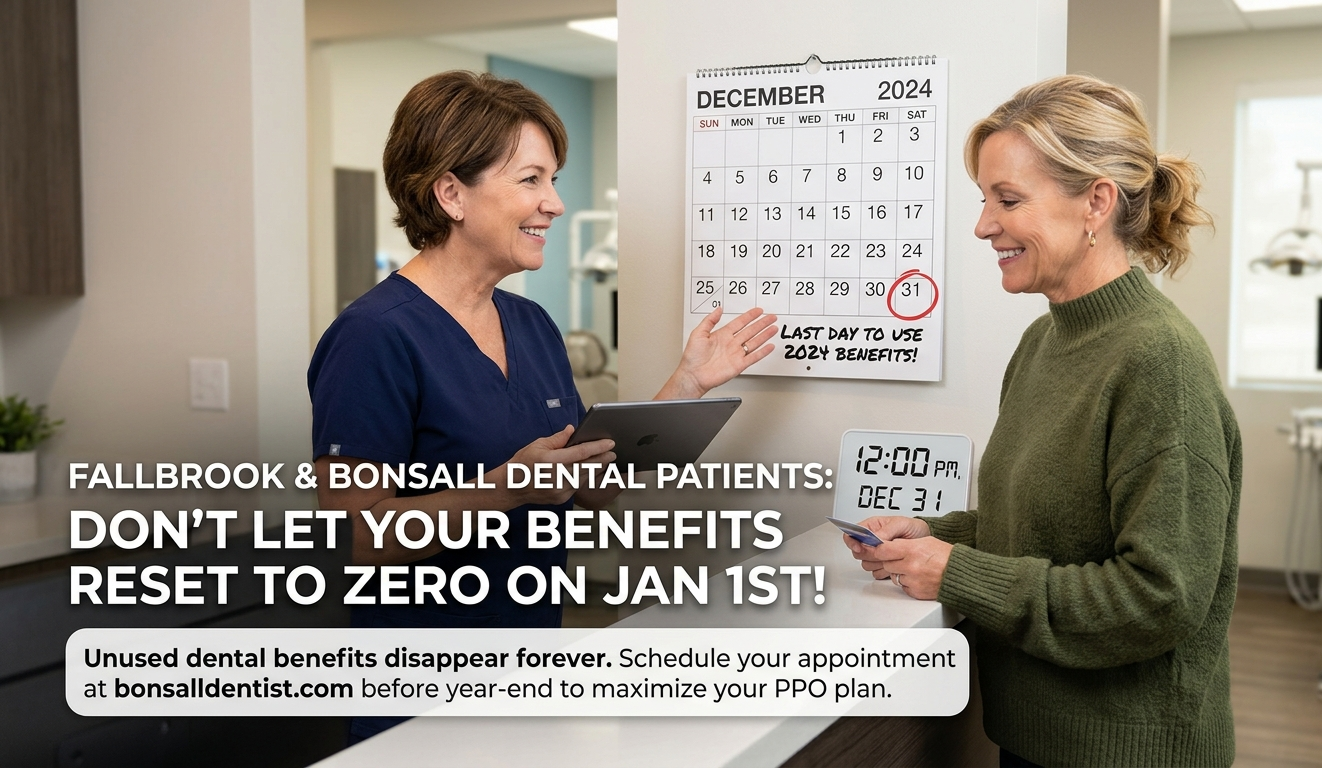
Here's something most dental patients don't find out until it's too late: on January 1st, your dental insurance benefits reset to zero. Any portion of your annual maximum you haven't used simply disappears — the insurance company keeps it, and you start the new year from scratch.
For patients in Fallbrook and Bonsall, this happens every single year. And every year, a significant amount of money that could have gone toward fillings, crowns, or other needed dental work goes unused.
Drs. Alexander Stanton and Christina Roberts have helped hundreds of North County patients understand their dental coverage and time their care strategically. This guide walks you through exactly how your benefits work — and how to make sure you're getting full value from them.
How PPO Dental Insurance Actually Works
If you have a PPO dental insurance plan — the most common type for patients in Fallbrook and Bonsall — your benefits are structured around three key numbers: your annual maximum, your deductible, and your coverage percentages.
The Annual Maximum
Your annual maximum is the total your insurance plan will pay toward your dental care in a calendar year. For most PPO plans, this falls somewhere between $1,000 and $2,000. Once you reach that ceiling, you are responsible for 100% of any additional treatment costs for the rest of the year.
Here's the part that matters most: unused benefits do not roll over. If your annual maximum is $1,500 and you only use $400 worth of benefits by December 31, the remaining $1,100 is gone. Your insurer does not refund it, bank it, or apply it to next year. It simply resets.
The 100/80/50 Coverage Structure
Most PPO plans divide dental services into three tiers, each covered at a different percentage:
- Preventive care — covered at 100%. This includes your routine cleanings, exams, and X-rays. Most plans cover two preventive visits per year at no cost to you. Importantly, preventive visits typically do not count against your annual maximum — meaning they are essentially free money sitting on the table if you haven't scheduled your second cleaning of the year.
- Basic restorative care — covered at 80%. This tier includes fillings, simple extractions, and similar treatments. Your insurance pays 80% and you pay the remaining 20% after your deductible is met.
- Major restorative care — covered at 50%. Crowns, bridges, dentures, and root canals fall here. Your plan pays half; you pay half. On a $1,400 crown, for example, your insurance covers $700 — which is meaningful savings, but only if you use it before the year ends.
Your Deductible
Most PPO plans also include an annual deductible — typically between $50 and $100 — that you pay before your percentage-based coverage kicks in for basic and major services. If you've already had any dental work done this year, your deductible is likely already met, which means any remaining treatment costs less out of pocket than it would have in January.
Why Year-End Is the Most Important Time to Think About Your Dental Care
The final quarter of the year — October through December — is the window when smart use of your dental benefits matters most. Here's why.
If your dentist has identified treatment you need but you've been putting off — a crown, a filling, a replacement for a failing restoration — completing that work before December 31 means your insurance contributes to the cost. Waiting until January means starting with a fresh deductible and a reset annual maximum, which pushes your out-of-pocket costs higher for no benefit.
At the same time, October and November are the latest you want to schedule. Dental offices fill up quickly in November and December as patients realize their benefits are about to expire. Scheduling early gives you flexibility on appointment times and enough runway to complete multi-visit treatments — like a crown, which sometimes requires two appointments — before the year closes.
If you're not sure whether you have benefits remaining, our front desk team can check your balance quickly and let you know exactly where you stand.
The Two Preventive Visits Most Patients Forget to Use
One of the most common ways patients leave money on the table is by missing their second cleaning of the year. Most PPO plans cover two preventive visits annually at 100% — no co-pay, no cost to you, and no impact on your annual maximum.
If you came in for a cleaning and exam in the spring and haven't been back since, you likely have a fully covered visit waiting for you before December 31. That visit includes a professional cleaning, an updated exam, and — critically — a chance for your dentist to identify any issues that can be addressed with remaining benefits before they reset.
Think of your second preventive visit as the annual check-in that protects everything else.
Common Dental Insurance Questions from Fallbrook & Bonsall Patients
Do unused dental benefits roll over to next year?
In almost all cases, no. The vast majority of PPO dental insurance plans reset hard on January 1. Any portion of your annual maximum you haven't used by December 31 is simply lost — it does not carry forward. This is one of the most costly misunderstandings patients have about their coverage, and it's the single biggest reason to take stock of your benefits before the year ends.
How do I find out how much of my annual maximum I've used?
You can call your insurance company directly and ask for your "remaining annual maximum" and "deductible status." Alternatively — and this is often faster — call our office. Our front desk team verifies benefits for patients regularly and can give you a clear picture of what's left and what upcoming treatment would cost you under your current plan.
Does my insurance cover dental implants?
Coverage for implants varies significantly by plan. Some PPO plans cover implants under the major restorative tier at 50%; others exclude them entirely. If you're considering implants, we recommend calling our office first so we can verify your specific plan's language before your consultation. We place and restore implants entirely in-house, which also reduces the total number of appointments and associated costs. Learn more about our implant services →
What if I need more treatment than my annual maximum covers?
This is more common than you might expect, especially for patients who need several things addressed at once. One approach is to strategically sequence treatment across two calendar years — completing the highest-priority work before December 31 using this year's benefits, then scheduling the next phase in January when your maximum resets. We help patients plan this kind of phased approach regularly, and it can significantly reduce total out-of-pocket costs.
Do you help with insurance filing and questions?
Yes — always. We handle claims filing on your behalf for all covered services and work with most major PPO dental insurance plans. Before any treatment, we provide a benefits breakdown so you know exactly what your insurance will cover and what you'll owe. No surprises.
Don't Let Your 2025 Dental Benefits Expire Unused
If you're a patient in Fallbrook, Bonsall, or anywhere in North San Diego County with PPO dental insurance, the end of the year is the time to act. Schedule your second cleaning, take care of any treatment your dentist has recommended, and let our team help you get full value from the benefits you've already paid for.
Drs. Stanton and Roberts are accepting new patients and would be glad to see you before year-end. We'll verify your benefits before your appointment and make sure your care is timed to work with your insurance — not against it.
Request your appointment at bonsalldentist.com or call our Bonsall office today. Spots fill quickly in the final months of the year — don't wait.
Related Posts
Dental Crowns in Fallbrook & Bonsall | Same-Day CEREC | Do I Need a Crown?

Dentist Near San Marcos, CA | Family Dental Care in Bonsall — 20 Min via Hwy 76
Your Child's First Dental Visit in Bonsall & Fallbrook | What to Expect