Does Teeth Whitening Work? An Honest Guide | Bonsall & Fallbrook Dentist
Yes — teeth whitening works. But how well it works, how long it lasts, and which method is actually worth your money depends on factors that most whitening ads don't bother to explain.
As dentists in Bonsall serving patients from Fallbrook and across North San Diego County, Drs. Stanton and Roberts hear the same questions about whitening every week: Is the professional version really better than what I can get at the drugstore? Will it make my teeth hurt? What about my crown — will that whiten too?
This post gives you the honest, complete answers — so you can make a confident decision about whether whitening is right for you, and which option will actually deliver the results you're looking for.
How Teeth Whitening Actually Works
All whitening products — professional and over-the-counter alike — rely on the same fundamental chemistry. The active ingredient, either hydrogen peroxide or carbamide peroxide, penetrates the outer layer of the tooth and breaks apart the molecular bonds of stain compounds that have accumulated in the enamel over time. The tooth structure itself isn't altered; the stains within it are chemically dissolved.
What separates professional whitening from the drugstore version isn't a different mechanism — it's concentration, contact time, and customization. Professional-grade whitening gel contains significantly higher concentrations of peroxide than anything available over the counter. Custom-fitted trays ensure the gel stays in uniform contact with every surface of the tooth. And dental supervision means the process is tailored to your specific enamel thickness, sensitivity level, and existing restorations.
The result is faster, more even, and more dramatic brightening than consumer products can reliably achieve.
Your Three Options — and What Each One Actually Delivers
In-Office Professional Whitening
In-office whitening is performed at our Bonsall dental office in a single appointment, typically lasting 90 to 120 minutes. A high-concentration professional whitening gel is applied directly to the teeth in carefully controlled conditions, with your gums and soft tissue protected throughout the procedure.
The results are immediate and significant — most patients leave the appointment four to eight shades brighter. If you have a special occasion coming up, a job interview, a wedding, or simply want the fastest possible transformation, in-office whitening is the most efficient path.
Cost in North San Diego County: $500-600
Time to results: Same day
Best for: Patients who want maximum results quickly or have a specific event in mind
Custom Take-Home Whitening Trays
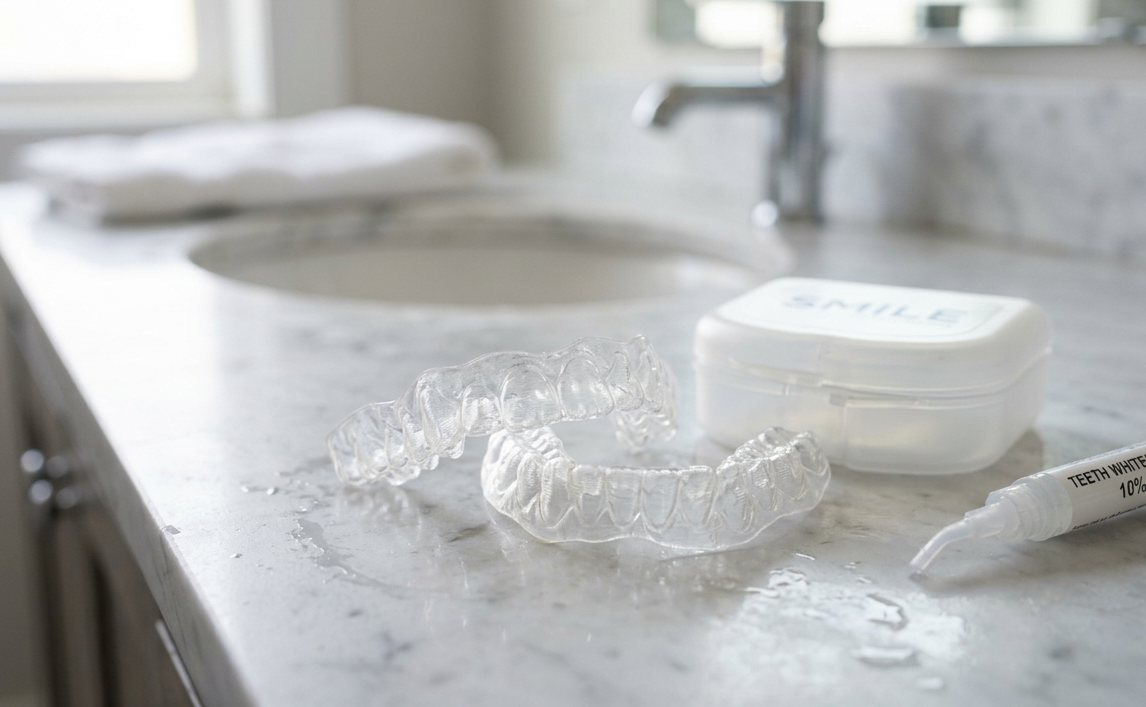
Custom take-home trays are, in our experience, the most practical whitening option for most patients. We take impressions of your teeth and fabricate trays that fit your exact dental anatomy — unlike the generic boil-and-bite trays found in drugstores, these cover every surface of every tooth without gaps or excess gel spilling onto the gums.
You wear the trays for a specified period each day — typically 30 to 60 minutes — over the course of one to two weeks. The results are comparable to in-office whitening, just achieved more gradually. The trays are yours to keep permanently and can be reloaded with additional gel for future touch-ups at a fraction of the original cost.
Cost in North San Diego County: $300
Time to results: 1–2 weeks of consistent use
Best for: Patients who want professional results at a lower upfront cost and the ability to maintain results long-term
Over-the-Counter Whitening Products
Whitening strips, trays, toothpastes, and LED kits are widely available and far less expensive than professional options — but the results reflect that difference. OTC whitening products use much lower concentrations of peroxide than professionally dispensed gels, which limits how much brightening they can achieve. Generic trays don't conform to individual tooth anatomy, leading to uneven contact and inconsistent results. And whitening toothpastes, while useful for maintaining results, don't contain peroxide at all — they work by gentle abrasion to remove surface staining, not by bleaching the enamel.
For patients with mild, surface-level staining from coffee or tea, OTC strips may provide a noticeable improvement. For anyone seeking meaningful, lasting brightening, the gap between OTC and professional results is significant enough that most patients who try both don't go back to the drugstore version.
Cost: $20–$80
Time to results: 2–4 weeks, with more modest outcomes
Best for: Maintenance between professional treatments, or mild surface staining on a tight budget
Who Is — and Isn't — a Good Candidate for Whitening
Whitening delivers its best results on healthy teeth with extrinsic staining — discoloration caused by external factors like coffee, tea, red wine, tobacco, and the natural aging process. Most adults fall into this category, and most will see meaningful improvement from professional treatment.
However, whitening isn't the right solution for everyone, and being honest about this is part of what makes a dental consultation valuable before you invest in treatment. You may not be an ideal candidate if:
- You have intrinsic staining. Discoloration caused by tetracycline antibiotics taken in childhood, fluorosis, or tooth trauma affects the inner structure of the tooth rather than the enamel surface. Bleaching has limited effectiveness on intrinsic staining — veneers or bonding typically deliver better outcomes for these cases.
- You have crowns, veneers, or composite fillings in visible areas. Whitening agents do not affect dental restorations. If you whiten your natural teeth, any existing crowns or fillings in your smile zone will remain their original shade — potentially creating a mismatch. This doesn't mean whitening isn't an option; it means the conversation needs to happen before treatment begins.
- You have untreated cavities or active gum disease. Whitening gel can penetrate compromised enamel and irritate exposed nerve tissue. Dental health needs to be addressed before any cosmetic treatment.
- You are pregnant or breastfeeding. Whitening is not recommended during pregnancy or while breastfeeding as a precautionary measure.
If you're unsure which category you fall into, a brief consultation at our Bonsall office is the most efficient way to find out. Request a cosmetic consultation →
Whitening FAQ: The Questions Fallbrook & Bonsall Patients Ask Most
Does teeth whitening work on crowns, veneers, or fillings?
No — and this is one of the most important things to understand before starting any whitening treatment. Whitening agents work exclusively on natural tooth enamel. Dental restorations — crowns, veneers, composite bonding, and fillings — are made from materials that do not respond to peroxide chemistry. They will stay exactly the shade they were when they were placed.
If you whiten your teeth without accounting for existing restorations, you may end up with natural teeth several shades brighter than a crown or filling in the same visible area. The solution isn't to avoid whitening — it's to plan your treatment with this in mind, which may mean replacing older restorations to match your new tooth color after whitening. This is exactly the kind of conversation we have with patients at our Bonsall office before any cosmetic treatment begins.
How long does teeth whitening last?
Professional whitening results typically last one to three years, though this varies considerably depending on your habits. Coffee, tea, red wine, and tobacco are the primary culprits in re-staining — patients who consume these regularly will notice gradual darkening sooner than those who don't. Daily brushing, regular cleanings, and using a straw for staining beverages all help extend your results.
The practical advantage of custom take-home trays is that maintenance is straightforward and inexpensive. Your trays last indefinitely, and a tube of touch-up whitening gel used for a few nights every 12 to 18 months is usually all it takes to keep your smile at its brightest.
Will whitening make my teeth sensitive?
Temporary sensitivity is the most common side effect of teeth whitening — and for most patients, it's mild and short-lived. It typically appears during treatment or in the 24 to 48 hours following, then resolves completely. Patients who already have sensitive teeth tend to experience more noticeable sensitivity during whitening.
If sensitivity is a concern, there are several ways to manage it: using a lower-concentration gel for a longer period, applying a desensitizing gel before and after treatment, or taking over-the-counter pain relief during the treatment window. We discuss all of this with patients before treatment begins, and we can customize a whitening protocol that balances results with your comfort level.
How much does professional whitening cost in Fallbrook or Bonsall?
In-office whitening at our Bonsall practice runs in the $500–$600 range, depending on the system used and the degree of treatment needed. Custom take-home trays with professional-grade gel are generally $300. Dental insurance does not typically cover cosmetic whitening procedures, though we're happy to discuss payment options. For most patients, the longevity and quality of professional results make it a worthwhile investment compared to repeatedly purchasing OTC products that deliver partial results.
Interested in a Brighter Smile? Here's Where to Start.
The first step isn't buying a whitening kit — it's a brief conversation with your dentist to confirm you're a good candidate, understand which option fits your goals and budget, and make sure any existing restorations are accounted for before treatment begins. That conversation takes ten minutes and saves patients from a lot of frustration and wasted money.
Drs. Stanton and Roberts offer professional whitening consultations for patients in Fallbrook, Bonsall, and all of North San Diego County. If a brighter smile is on your list, we'd love to help you get there.
Request your appointment at bonsalldentist.com or call our Bonsall office today.
Related Posts

Bad Breath in Fallbrook & Bonsall: Causes & What Actually Fixes It
Tooth Extraction in Fallbrook & Bonsall: When It's Necessary & What Comes Next
Diabetes & Dental Health in Fallbrook & Bonsall | What Every Diabetic Patient Should Know