TMJ & Jaw Pain in Fallbrook & Bonsall: Causes, Symptoms & What Actually Helps
Jaw pain is one of those symptoms people tend to ignore for longer than they should. It comes and goes. It seems connected to stress. It doesn't feel like a dental problem. And so it sits — sometimes for years — while the underlying cause quietly does more damage.
At our Bonsall office, Drs. Alexander Stanton and Christina Roberts see TMJ-related symptoms regularly — jaw clicking, morning soreness, facial tension, headaches that patients have been attributing to everything except their teeth. The good news is that most TMJ disorders respond well to conservative treatment. The key is understanding what's actually happening and addressing it before the symptoms escalate. This guide covers everything Fallbrook and Bonsall patients ask us about jaw pain, from what the TMJ is to what actually works.
What the TMJ Is — and What Can Go Wrong
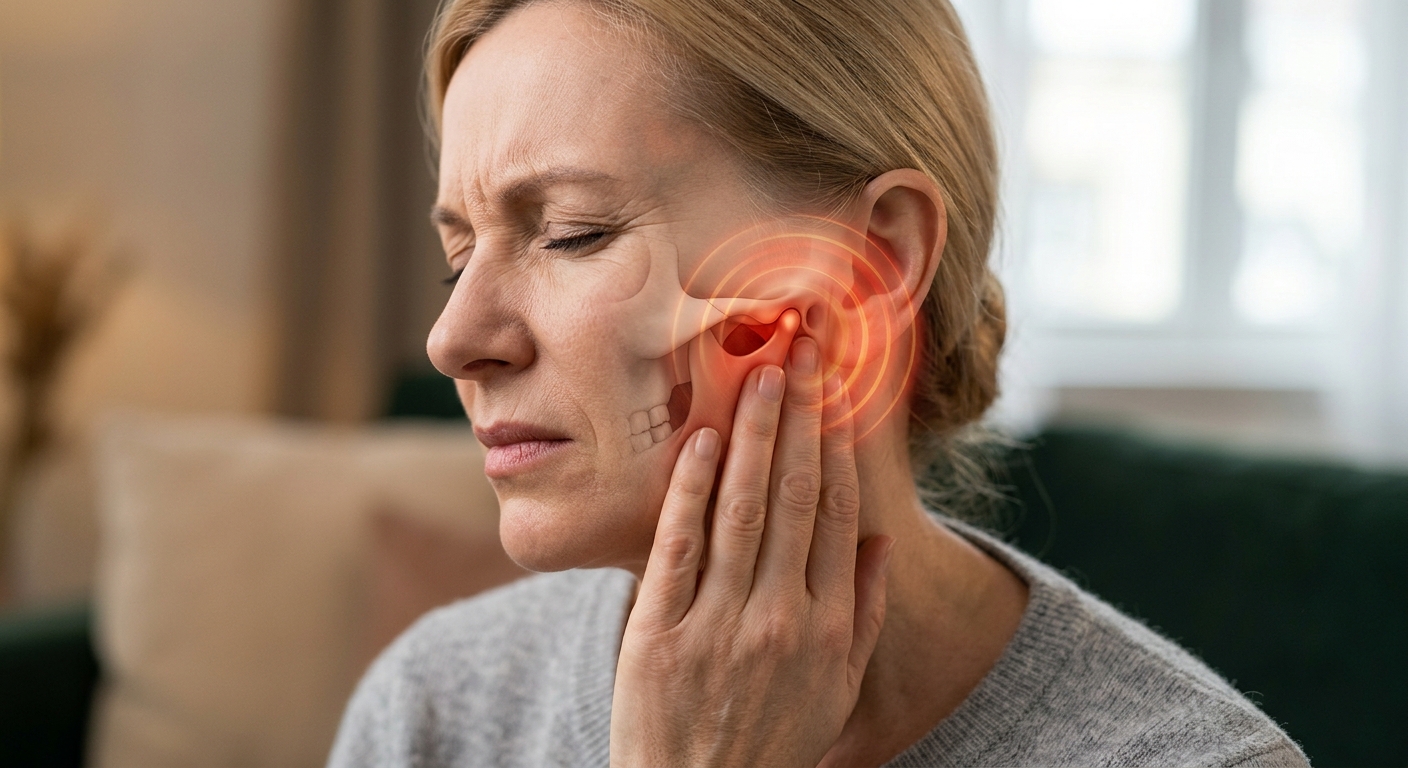
The temporomandibular joint (TMJ) is the hinge joint that connects your lower jaw to the temporal bone of your skull, located just in front of each ear. You have one on each side. These joints are involved in virtually every movement your mouth makes — chewing, speaking, yawning, swallowing — making them among the most frequently used joints in the entire body.
What makes the TMJ particularly complex is its structure. Unlike most joints, it contains a small disc of cartilage between the bones that acts as a cushion and allows the smooth gliding motion required for a full range of jaw movement. The joint is also surrounded by an extensive system of muscles — primarily the masseter, temporalis, and pterygoid muscles — that control jaw movement and bear the considerable forces generated during chewing and clenching.
TMJ disorder (TMD) is an umbrella term for problems involving the joint itself, the disc inside it, or the muscles surrounding it. The most common presentations are:
- Myofascial pain — muscle tension and soreness in the jaw, face, neck, and shoulders, most commonly caused by clenching and grinding (bruxism)
- Internal derangement — displacement of the disc inside the joint, producing clicking, popping, or locking during jaw movement
- Degenerative joint disease — arthritis affecting the joint surfaces, more common in older patients and typically producing a grating sensation rather than a click
These categories frequently overlap. Many patients have both muscle-related pain and some degree of disc displacement, and distinguishing between them — which requires an examination — is important because the treatment approaches differ.
Clenching, Grinding, and the Symptoms People Don't Connect to Their Teeth
The most common cause of TMJ-related symptoms seen at our Bonsall office is bruxism — the involuntary clenching and grinding of teeth, which most often happens during sleep. Most patients who clench have no idea they're doing it. Their partner may have mentioned hearing grinding sounds at night. They wake up with their jaw already tired. But the connection between what happens at night and what they feel during the day is rarely obvious without someone pointing it out.
Morning Headaches
The masseter muscles — the large chewing muscles that run along the sides of the jaw — are among the strongest muscles in the human body relative to their size. During sleep bruxism, these muscles can generate significant force over several hours. The result is chronic muscle tension that radiates upward into the temples, behind the eyes, and sometimes down into the neck and shoulders. Patients who wake up with a headache nearly every morning, or who have been managing tension headaches for years without a clear cause, are frequently found to be clenchers when they're finally evaluated for it.
Jaw Soreness and Facial Tension
Morning soreness in the jaw, cheeks, or temples — a feeling of tightness or fatigue before the day has even started — is a classic sign of nighttime clenching. The muscles have been working for hours and are presenting exactly the way any overused muscle presents: sore, tight, and slow to release.
Tooth Wear and Sensitivity
Over time, bruxism wears down tooth enamel — the hard outer layer that protects teeth from temperature and pressure. Worn enamel leads to increased sensitivity to hot, cold, and sweet foods, and eventually to changes in the shape and height of the teeth that affect bite function. Patients who come in describing sensitivity on multiple teeth with no obvious decay are frequently found to have significant enamel wear from grinding.
Clicking and Popping
The clicking or popping sensation some patients feel when opening or closing their mouth is caused by the cartilage disc inside the joint shifting out of position as the jaw moves. Occasional clicking without pain is extremely common and, in the absence of other symptoms, may not require treatment. Clicking accompanied by pain, limited opening, or a jaw that intermittently locks open or closed is a different situation and warrants evaluation.
What Actually Helps — and What Doesn't
TMJ disorders have a reputation for being difficult to treat, which is partly deserved — severe cases involving significant joint damage can be genuinely complex. But the majority of patients presenting with TMJ-related symptoms have muscle-driven pain that responds well to conservative, reversible treatment. Starting with the least invasive options is always the right approach.
A Custom Nightguard
For patients whose jaw pain, headaches, or tooth wear is driven by nighttime clenching and grinding, a custom-fitted nightguard is the most effective first-line treatment. The appliance — made from dental impressions of your teeth — fits precisely over the upper or lower arch and creates a physical barrier between the teeth during sleep. It doesn't stop the clenching habit, but it prevents the teeth from making direct contact, dramatically reducing the force transmitted to the jaw joints and muscles.
The difference between a custom nightguard and an over-the-counter version from a pharmacy matters more than most patients realize. Store-bought guards are made from generic molds that rarely fit well, and a poorly fitting appliance can actually increase muscle tension rather than relieve it. A custom guard made from a dental impression fits precisely, distributes bite forces evenly, and is far more comfortable to wear — which means patients actually keep it in all night rather than taking it out at 2 a.m.
Jaw Exercises and Habit Awareness
Daytime clenching — which often happens unconsciously during concentration, stress, or physical exertion — contributes to jaw muscle pain even in patients who primarily clench at night. Developing awareness of the habit ("lips together, teeth apart") and performing simple jaw stretching exercises recommended by your dentist can meaningfully reduce daytime muscle tension. These are free, require no equipment, and are something patients can start immediately.
Heat and Anti-Inflammatories
Applying moist heat to the jaw muscles for 10 to 20 minutes, combined with over-the-counter anti-inflammatory medication (ibuprofen or naproxen), provides short-term relief during flare-ups. These are symptomatic treatments, not solutions, but they're appropriate while the underlying cause is being addressed.
What to Avoid
During a TMJ flare-up, avoiding hard, chewy, or tough foods — bagels, raw carrots, thick steaks, chewing gum — reduces the demand on already-inflamed jaw muscles. Avoiding wide opening (such as during a very large yawn or certain dental procedures) is also helpful while symptoms are active. These modifications don't fix the underlying problem but they prevent symptoms from being aggravated.
When Conservative Treatment Isn't Enough
A small percentage of TMJ patients — those with significant disc displacement, degenerative joint changes, or bite problems contributing to the dysfunction — may need referral to an oral and maxillofacial specialist for more advanced evaluation and treatment. At our Bonsall office, we assess every patient's situation individually and are straightforward about when a case is beyond what conservative treatment can address. That's the exception, not the rule — but it's important to know the distinction.
Jaw Pain or Morning Headaches in Fallbrook or Bonsall? Let's Take a Look.
TMJ-related symptoms are common, often underdiagnosed, and in most cases very manageable with the right approach. If you've been living with jaw soreness, clicking, facial tension, or morning headaches that haven't had a clear explanation, a dental evaluation is a logical and often productive place to start.
Drs. Stanton and Roberts welcome new patients from Fallbrook, Bonsall, and across North San Diego County. We'll evaluate what's going on, explain your options clearly, and recommend the most conservative approach that's likely to help.
Request your appointment at bonsalldentist.com or call our Bonsall office today.
Related Posts
TMJ & Jaw Pain in Fallbrook & Bonsall: Causes, Symptoms & What Actually Helps

Your Dental Benefits Expire Dec 31 — Use Them Before They’re Gone

Looking for a Dentist Near Escondido, CA? Why North County Families Drive to Bonsall