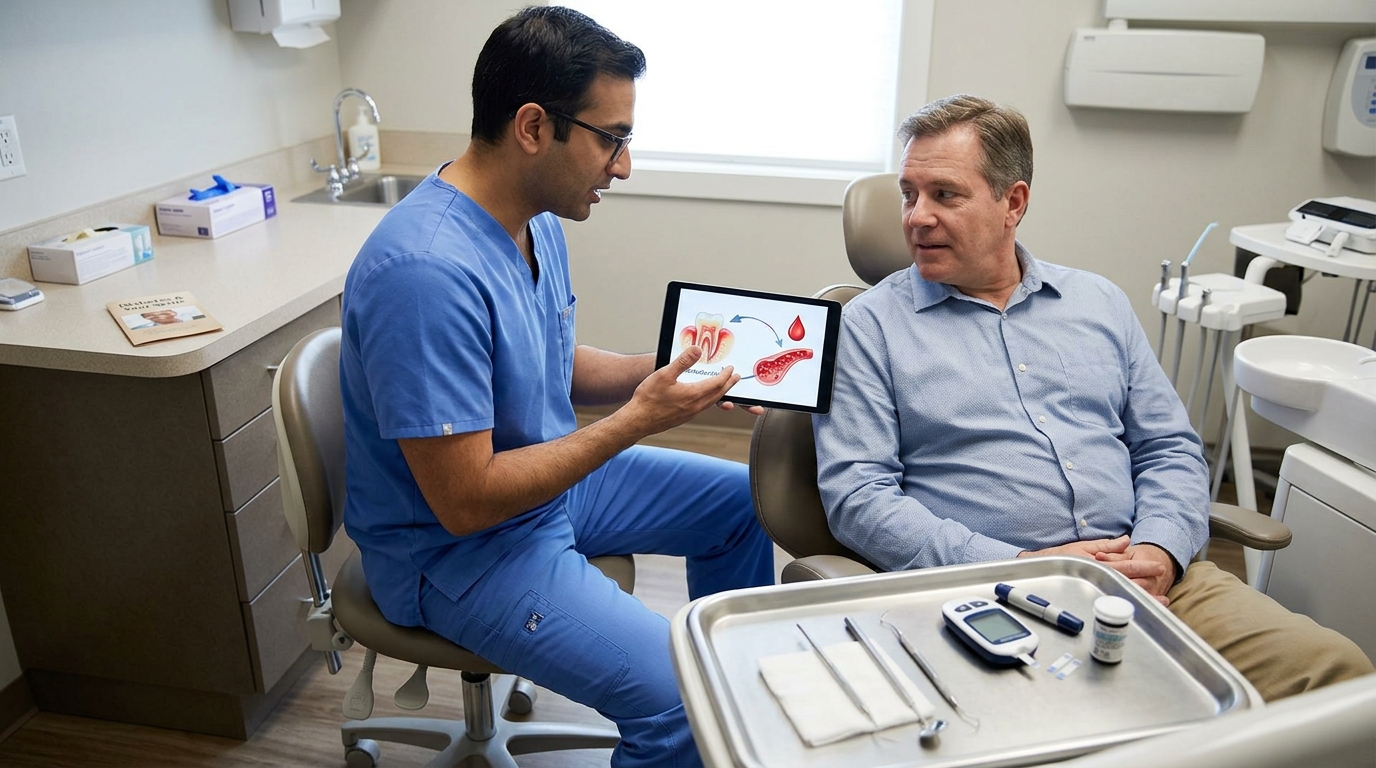
Diabetes & Dental Health in Fallbrook & Bonsall | What Every Diabetic Patient Should Know
If you have diabetes and you're managing your blood sugar, watching your diet, and keeping up with your medical appointments, you may not have given much thought to what diabetes is doing to your mouth. But the relationship between diabetes and oral health is one of the most clinically significant connections in all of medicine — and it runs in both directions.
Drs. Alexander Stanton and Christina Roberts see a significant number of patients with diabetes at their Bonsall practice, serving the Fallbrook and North San Diego County communities where this condition is common across the 60-and-older demographic particularly. Understanding how diabetes affects your dental health — and how your dental health affects your diabetes — is one of the most important things you can do for your overall wellbeing.
The Bidirectional Relationship: How Diabetes and Gum Disease Affect Each Other
The connection between diabetes and gum disease is not a one-way street, and that distinction matters enormously.
How Diabetes Affects Your Gums
Diabetes impairs the immune system's ability to fight bacterial infection throughout the body — including in the mouth. When blood sugar is elevated, harmful oral bacteria thrive in the sugar-rich environment, plaque accumulates more aggressively, and the body's inflammatory response to that bacterial load is both stronger and less effective at resolving the infection. The result is that diabetic patients are two to three times more likely to develop serious gum disease than non-diabetic patients, and when gum disease does develop, it tends to progress more rapidly and be more difficult to treat.
High blood sugar also reduces saliva production — and saliva is one of the mouth's primary defenses against bacteria and tooth decay. Dry mouth compounds the already elevated infection risk, accelerates cavity formation, and creates the environment in which oral fungal infections like thrush (oral candidiasis) take hold more easily.
Healing is also impaired. After any dental procedure — a tooth extraction, a deep cleaning, even a filling — tissue healing in diabetic patients is slower and the risk of post-procedure infection is higher. This is not a reason to avoid necessary dental treatment; it's a reason to make sure your dental provider knows about your diabetes so treatment can be planned and monitored accordingly.
How Gum Disease Affects Your Diabetes
This is the part of the relationship that surprises most patients — and that makes oral health a genuine medical priority for anyone managing diabetes.
Gum disease is a chronic bacterial infection. Like any chronic infection, it generates a persistent inflammatory response throughout the body. That systemic inflammation interferes with insulin signaling, making cells less responsive to insulin and blood sugar harder to control. Multiple well-designed studies have now demonstrated that patients with poorly controlled gum disease have significantly elevated HbA1c levels — the standard marker of long-term blood sugar control — and that treating gum disease leads to measurable improvements in that number.
In practical terms, this means that a diabetic patient with untreated gum disease is fighting a battle on two fronts simultaneously: the inflammation from gum disease is actively working against the blood sugar management they're trying to achieve through medication, diet, and lifestyle. Treating the gum disease removes that inflammatory burden — and clinical evidence shows it helps.
Your dentist and your physician are, in a very real sense, on the same team when you have diabetes. We've written in more detail about the systemic health connections to oral health in our post on The Heart-Smile Connection and in our Gum Disease guide — both of which are relevant reading alongside this one.
Why Diabetic Patients Need More Frequent Dental Care
The standard recommendation of two dental cleanings per year is designed for patients with a normal immune response and average infection risk. Diabetic patients — particularly those with less well-controlled blood sugar — don't fit that profile, and the standard interval is often insufficient.
Most diabetic patients benefit from dental visits every three to four months. Here's why more frequent care matters:
- Bacterial populations rebuild quickly. After a professional cleaning, the harmful bacteria in periodontal pockets begin repopulating almost immediately. In a healthy patient, six months of bacterial accumulation creates manageable levels of inflammation. In a diabetic patient, the same six months can mean significantly more damage, particularly if blood sugar is not well controlled.
- Changes progress faster. Gum recession, bone loss, and pocket deepening occur more rapidly in diabetic patients. Monitoring every three to four months means catching those changes before they become irreversible rather than finding significant progression at a six-month visit.
- Motivation and support. More frequent contact with your dental team means more consistent reinforcement of home care habits, earlier identification of new problems, and ongoing guidance on how to minimize infection risk between visits.
The appropriate interval for your specific situation depends on how well your blood sugar is controlled, whether you already have gum disease, and how your gums respond to treatment. Drs. Stanton and Roberts will recommend the right schedule at your visit and adjust it as your health picture changes.
What to Tell Your Dentist — and When to Update Them
For diabetic patients, the relationship with your dental provider should be an active, ongoing dialogue — not just a form filled out once at the new patient appointment. Here's what we need to know and when:
At Every Visit
- Your current blood sugar control status — is it well managed, or has it been difficult recently?
- Your most recent HbA1c result if you know it
- Any changes to your diabetes medications since your last visit
- Whether you've experienced any hypoglycemic episodes recently
- Whether your physician has made any changes to your diabetes management plan
Immediately, If Any of These Change
- A significant change in blood sugar control — either improved or worsened
- A new diabetes-related complication such as neuropathy or kidney disease, which can affect treatment planning
- A new medication that may affect healing, bleeding, or saliva production
- A planned surgical or invasive dental procedure — your physician may want to be consulted
We also want to know if your blood sugar is running high on the day of an appointment. For some procedures, we may recommend rescheduling if blood sugar is significantly elevated — healing and infection risk are both affected, and it's better to treat under optimal conditions when possible.
Warning Signs Diabetic Patients Should Never Ignore
Because diabetes accelerates the progression of oral conditions and impairs healing, certain symptoms warrant a prompt call to our Bonsall office rather than a wait-and-see approach:
- Gums that bleed when you brush or floss — even occasionally
- Gums that look red, swollen, or have pulled away from the teeth
- Persistent bad breath that doesn't resolve with brushing
- Teeth that feel loose or have shifted
- Sores or wounds in the mouth that are slow to heal
- Dry mouth that is persistent or worsening
- White patches on the tongue or inside the cheeks (possible thrush)
- Burning or tingling sensations in the mouth or on the tongue
In non-diabetic patients, some of these symptoms might be monitored over time. In diabetic patients, they represent the leading edge of conditions that can progress significantly faster — prompt evaluation is always the right call.
Managing Diabetes in Fallbrook & Bonsall — Your Dental Team Is Part of That.
If you have diabetes and you haven't discussed it fully with your dental provider — or if you're looking for a dental practice in Fallbrook or Bonsall that understands the connection between systemic health and oral health — Drs. Stanton and Roberts would be glad to be your dental home.
We take medical history seriously, we coordinate care with your physician when appropriate, and we build dental schedules around your individual health picture rather than a one-size-fits-all calendar. That's what good dental care looks like for a diabetic patient — and it's what we offer.
Request your appointment at bonsalldentist.com or call our Bonsall office today. We look forward to being part of your care team.
Related Posts
Diabetes & Dental Health in Fallbrook & Bonsall | What Every Diabetic Patient Should Know
Dental Crowns in Fallbrook & Bonsall | Same-Day CEREC | Do I Need a Crown?

Dentist Near San Marcos, CA | Family Dental Care in Bonsall — 20 Min via Hwy 76